
The Self That Reports
AbstractA companion paper develops the Boundary–Membrane Integrative Core (BMIC), a falsifiable model inwhich a low-dimensional global state, C(t), coordinates an organism’s physical subsystems, and deliberatelystops…

Living organisms stay coherent wholes even though their molecules turn over, their control is distributed
across many systems, and they constantly exchange matter and energy with their environment.
Consciousness science possesses quantitative markers of neural integration,
differentiation, criticality, multisensory inference, and bodily self
consciousness, yet lacks consensus on the organizational conditions supporting
unified first-person experience. Gravity is universal to ordinary physical
systems; conscious experience is selective.
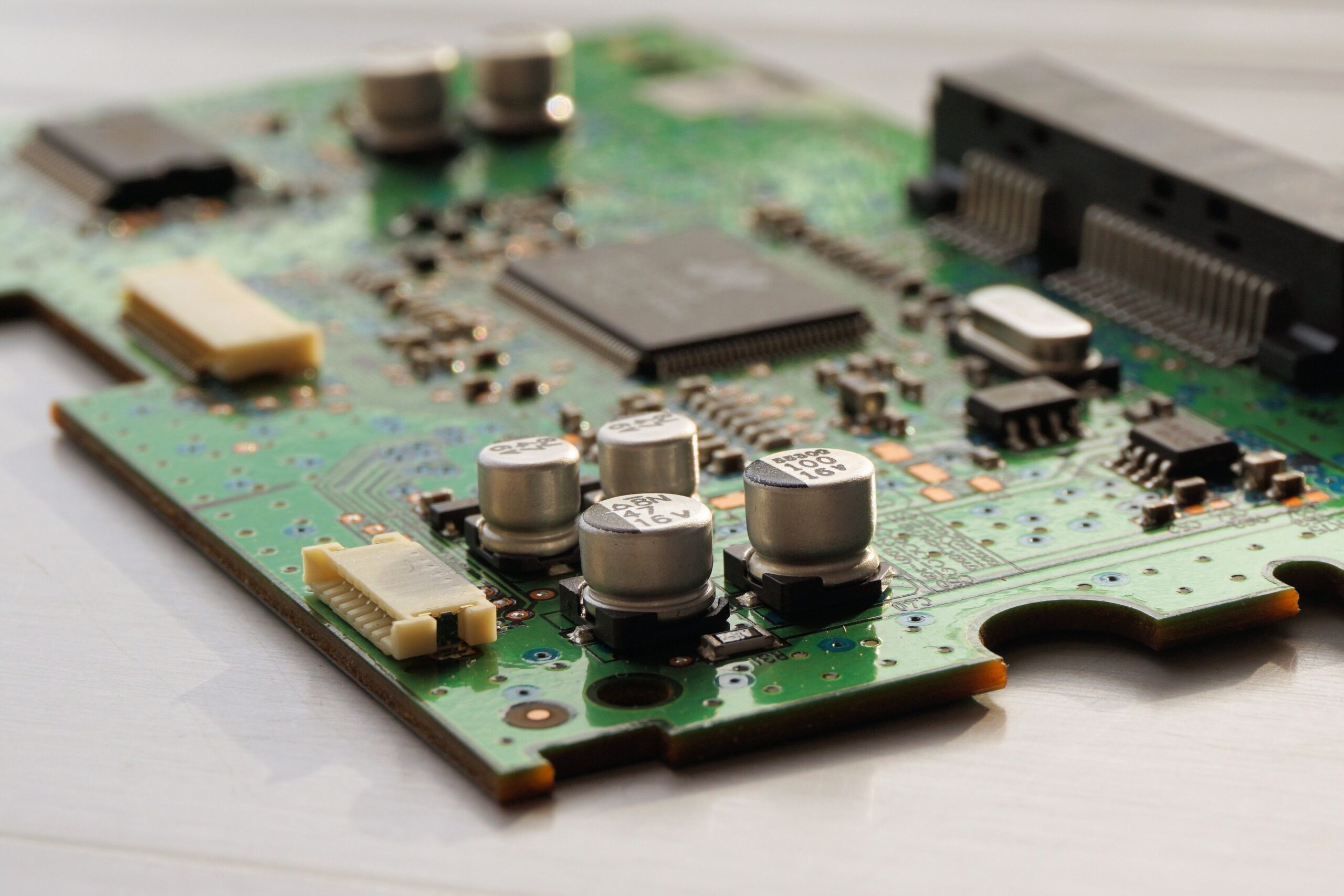
The importance of the inspection process has been magnified
both functional and cosmetic defects. With the advances
in computers(including high speed, large memory,andlow
by therequirements of the modernmanufacturingenvironment.
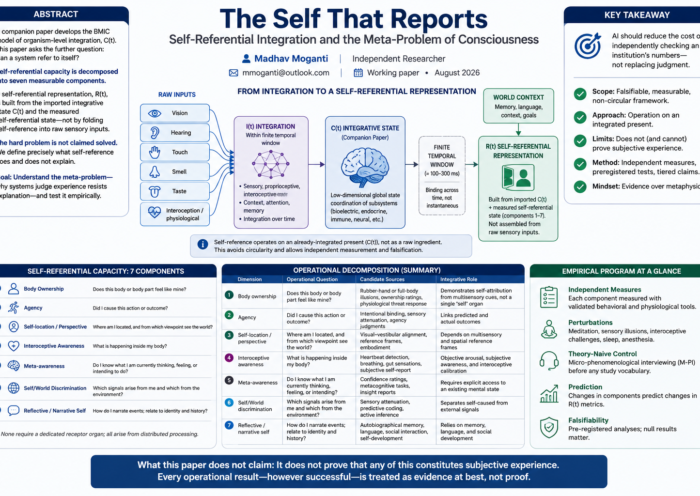
Abstract
A companion paper develops the Boundary–Membrane Integrative Core (BMIC), a falsifiable model in
which a low-dimensional global state, C(t), coordinates an organism’s physical subsystems, and deliberately
stops short of any claim about subjective experience. This paper takes up that further question directly,
under its own, stricter evidential standard. Self-referential capacity — body ownership, agency, self
location, interoceptive awareness, metacognitive access, and self/world discrimination — is decomposed
into seven independently measurable components, none proposed as a dedicated receptor organ.
Abstract
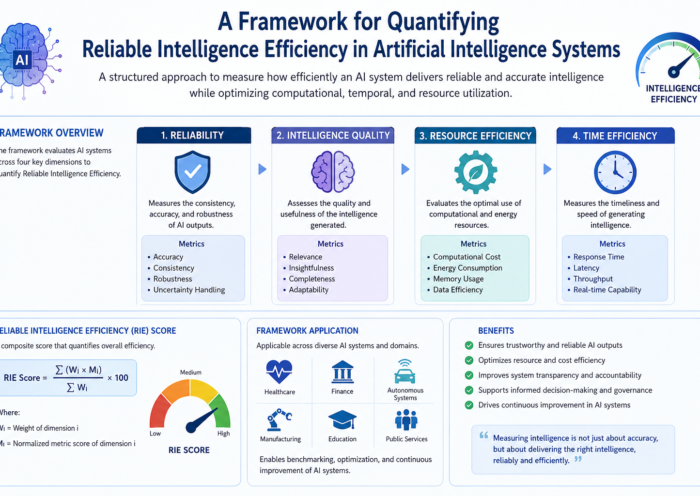
Artificial intelligence has advanced rapidly through scaling of model parameters, datasets, “
“and computational resources. Scaling laws have demonstrated predictable improvements in model “
“capability; however, capability alone does not fully describe the value of an AI system deployed “
“in real-world environments.
Abstract
For a fixed hardware generation and a fixed task-success threshold, broadening the admissible task and input scope is
hypothesized to increase energy per verified successful output and the cost of achieving specified verification coverage.